

Try this experiment. Book a meeting room, invite six people, and run a standard 40-minute focus group. Now imagine that two of those participants can't see the flipchart and can't hear the person next to them. Everything you know about facilitation collapses in about ninety seconds. Not because the method is wrong, but because none of the scaffolding was built for them.
I learned this the hard way on a small qualitative study a few years ago where one participant was deafblind. I had done what I thought was careful prep: a large-print handout, an interpreter booked, a quiet room. It fell apart. The interpreter was positioned facing me instead of facing the participant. My handout was useless because the participant used tactile signing, not large print. I spent the session improvising, and the data I collected was thin and probably skewed by my own clumsiness.
So let's talk properly about accessible research methods for deafblind participants — not the glossy version, but the practical one. What actually works, what wastes everyone's time, and where most researchers quietly get it wrong.
Key Takeaways
- Deafblindness is a spectrum, not a single profile. Congenital and acquired deafblindness demand completely different research designs.
- Intervenors are not interpreters. They have different training, different ethics, and a different role in the data-collection room.
- Consent needs to be process-based, not a signature on a form — it has to be re-confirmed at every stage.
- Recruitment rarely fails because deafblind people aren't interested. It fails because researchers use channels they can't access.
- Budget for two to three times the usual session length. Rushing tactile communication corrupts your data.
- Returning results in accessible formats isn't a courtesy. It's part of the method.
Why accessible methods for deafblind participants keep failing
The core problem isn't lack of goodwill. It's that most research methods were designed around two assumptions that quietly exclude deafblind people: that information arrives visually, and that it arrives auditorily. Remove either one and the method still limps along. Remove both and it stops.
Here's what surprises people: deafblindness isn't rare. Most estimates put it at roughly 1 in 3,000 to 1 in 4,000 people in developed countries, and it climbs sharply with age. The vast majority of deafblind adults acquired their vision and hearing loss later in life — often gradually, often through conditions like Usher syndrome or age-related degeneration. Congenital deafblindness is a much smaller group, but it's the one that gets the most attention in textbooks and the least practical coverage in methods chapters.
The two profiles that change everything
If you take one thing from this article, take this: you cannot design one study and run it across both congenital and acquired deafblindness.
- Someone with congenital deafblindness has likely used tactile sign language, Protactile, or another embodied communication system since early childhood. Their language is fully developed. Your problem is learning to receive it, not teaching it.
- Someone with acquired deafblindness may have spoken language as their primary channel and no signing background at all. They may use speech, hearing aids for residual hearing, or clear-speech strategies. Your problem is completely different.
- Someone with additional disabilities — cognitive, motor, or otherwise — needs a third design entirely, usually with a familiar communication partner present the whole time.
I've watched researchers recruit a mixed group, run one protocol, and then wonder why half the session produced nothing usable. The method matched none of them well enough.
Communication methods that actually work in the field
The question I get asked most often, usually by a researcher who has just realised their IRB-approved protocol won't survive contact with reality, is some version of: how do I actually talk to a deafblind participant?
There's no single answer. But there are a handful of approaches that hold up across most contexts, and knowing which one fits your participant is half the work.
Tactile signing and Protactile
Tactile signing means the participant places their hands over the signer's hands to feel the signs as they're made. Protactile goes further — it's a distinct language system developed by and for deafblind people that uses touch on the body as a primary grammatical channel, not a substitute for vision.
If your participant uses either, everyone in the room who communicates with them needs to be fluent, not just the interpreter. That includes you, if you're asking follow-up questions. Watching a third party relay your questions back and forth adds lag, strips nuance, and — this is the part people underestimate — silently changes your data because the participant can't tell whether they're answering you or the interpreter.
The intervenor vs interpreter distinction (and why it matters)
These two roles get merged constantly in research write-ups, and that's a mistake with real consequences.
| Role | Primary function | Ethical position in research |
|---|---|---|
| Interpreter | Relays language faithfully between parties | Neutral, does not shape content |
| Intervenor | Provides access, orientation, environmental information, and often communication support | Not neutral — participates in the person's access to the world |
| Support person / familiar partner | Someone the participant already knows and trusts | Carries relationship history; can both help and bias |
An intervenor might tell a participant that the room is warm, that someone just entered, or that the researcher is looking confused. That's information the participant has a right to. But it also means the intervenor is shaping what the participant knows, and therefore what they can respond to. If you write them into your methods section as "interpreter," you're misrepresenting your own study.
Communication failures I have made (so you don't have to)
The first session I ran with tactile signing, I positioned myself at a table across from the participant. Wrong. In tactile communication, physical orientation is not a formality — it's the whole channel. I should have been beside them or directly in front, with our hands in a workable plane, and I should have asked them where they wanted me rather than guessing.
Second mistake: I used a written consent form with a signature line. My participant couldn't read it. We eventually worked through the content verbally with the interpreter, but the form itself was a wall I'd built without thinking.
Third: I scheduled a two-hour session. It needed four. Tactile communication is slower. Not because it's less efficient, but because it's physically demanding and requires pacing. If you plan a 90-minute interview and book a room for two hours, you will either rush the participant or lose the last third of your questions.
Adapting your materials, your room, and your consent process
Accessibility in research isn't a checklist you tick once. It's a set of decisions you revisit as the study moves.
Accessible consent is a process, not a document
A standard informed consent form assumes the participant can read it, see your face, hear your explanation, and sign their name. For many deafblind participants, none of those assumptions hold.
What works better:
- Explain the study in the participant's own communication mode, with time for questions that isn't compressed.
- Confirm understanding by asking the participant to describe the study back in their own words — and don't accept a nod as sufficient.
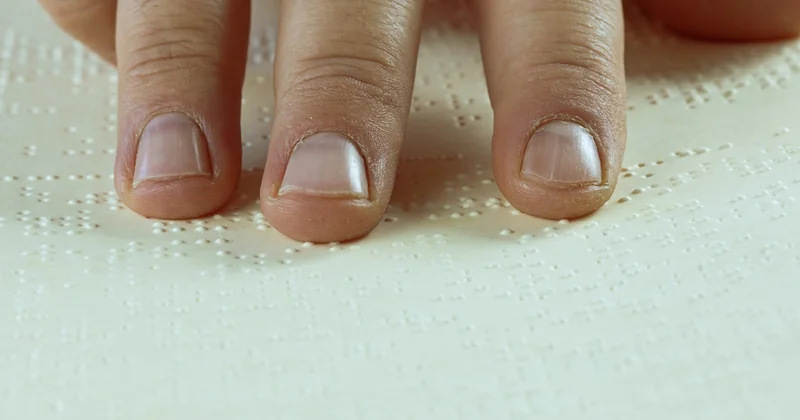
- Use whatever form of record-keeping the participant finds acceptable: verbal consent recorded with their agreement, a witnessed statement, or an accessible document in braille or electronic text.
- Re-confirm at the start of every session. Consent isn't a one-time gate. It's ongoing.
I'll be honest: on my first attempt I treated consent as a formality to clear before the "real" work started. That was backwards. The consent conversation is the first thing that tells your participant whether you've done the work to make the rest of the session accessible. If it's clumsy, they know the whole study will be clumsy.
The physical environment quietly determines your data quality
Lighting, seating, hand position, and room noise — every one of these matters more than you'd expect. A few things that have made a real difference in my sessions:
- Confirm with the participant where they want you positioned before the session begins. Don't assume.
- Keep the room layout stable across sessions. Moving furniture between visits adds confusion that looks like fatigue.
- Have water within reach. Tactile communication is physical work.
- Plan an exit ramp. If the participant needs a break, the session has to accommodate it without losing time.
Recruitment that actually reaches deafblind participants
Researchers often complain that they "can't find" deafblind participants. In my experience that's almost always a channel problem, not a population problem.

What doesn't work: standard email lists, university participant pools, social media ads with visual copy, and phone-based screening. All of those assume the very access you're supposedly studying.
What does work: partnerships with deafblind organisations and consumer groups, referrals through intervenor services, working through professionals who already have established communication with individuals, and — critically — letting participants recruit peers once they trust you. Word of mouth inside the community is far more effective than any institutional channel.
Roughly speaking, expect recruitment to take two to three times longer than a comparable study with hearing-sighted participants. If you build that into your timeline, you'll be fine. If you don't, you'll be tempted to cut corners on access to hit your numbers — and your data will show it.
Reciprocity: what you owe participants after the study ends
The single most common failure I see isn't in the data collection. It's what happens after. Participants who gave hours of their time — often more than the study scheduled — get nothing back.
At minimum, results should be returned in a format the participant can actually access. Braille, large print, audio, tactile, or a live session in their communication mode. A PDF emailed to an address they can't read is not a result.
Beyond that: consider whether participants should be co-researchers rather than subjects. Some of the strongest studies I've seen in this space were designed with deafblind advisors from the start — not consulted at the end. It changes the questions you ask, the framing of your interview guide, and frankly the honesty of your findings.
And pay people. Compensation is not a small thing. If you're asking for physical effort that drains someone for the rest of their day, compensate accordingly.
What this means for your next study
The methods aren't exotic. Tactile communication, intervenor roles, process consent, accessible materials — none of this is obscure knowledge. It's just rarely written into the standard methodological playbooks, so researchers default to whatever they learned in grad school, and then wonder why participant recruitment stalls.
What I keep coming back to is this: accessibility isn't a layer you add to a finished design. It is the design. If you build the study for the most access-constrained participant first, everyone else fits more easily. If you build it for the median participant and try to bolt access on afterward, you'll be improvising in the meeting room — and I can tell you from experience that improvising costs you data you'll never get back.
The next time someone tells you that accessible research methods for deafblind participants are too complicated, ask them how many methods they've actually tried. Usually the answer is one. Sometimes zero. There's a longer list waiting, and it's not complicated. It just takes longer, and it takes asking.


